

The Missing 75%: The 4 Pillars Every Basketball Player Needs to Develop
The Missing 75%
The 4 Pillars Every Basketball Player Needs to Develop
The 4 pillars
Training
Physical development and skill development.
Nutrition
Fuel your body so you can perform.
Recovery
Sleep is the one thing that supports everything else.
Mindset
What separates the good from the great.
The missing 75%
Level Up Your Game
Are you trying to take your game to the next level?
Move up from JV to Varsity?
Get that D1 scholarship?
Or find a way to eventually make it as a pro?
Well, unless your name is KD, LeBron, or Ant Edwards, you don’t have the luxury of leaving performance on the table.
(And if you ARE one of those guys and you’re reading this article, WELCOME! Make sure to hit your boy up for some training.)
If you want to reach your full potential as a player, you need to understand that there are a lot of levers you can pull to get the most out of your body.
It might not be on your first visit, but if you work with me long enough, we’re going to talk about the 4 key areas you need to develop to play at your best:
- Training and Physical Development
- Nutrition and Fueling
- Recovery and Regeneration
- Mindset and Mental Performance
Each one is a lever you can pull to level up your game.
So let’s dive in and see how YOU can get better both on and off the court!
Pillar 01
Training and Physical Development
If you’re here, you’ve probably heard me talk or write about physical development.
And for good reason!
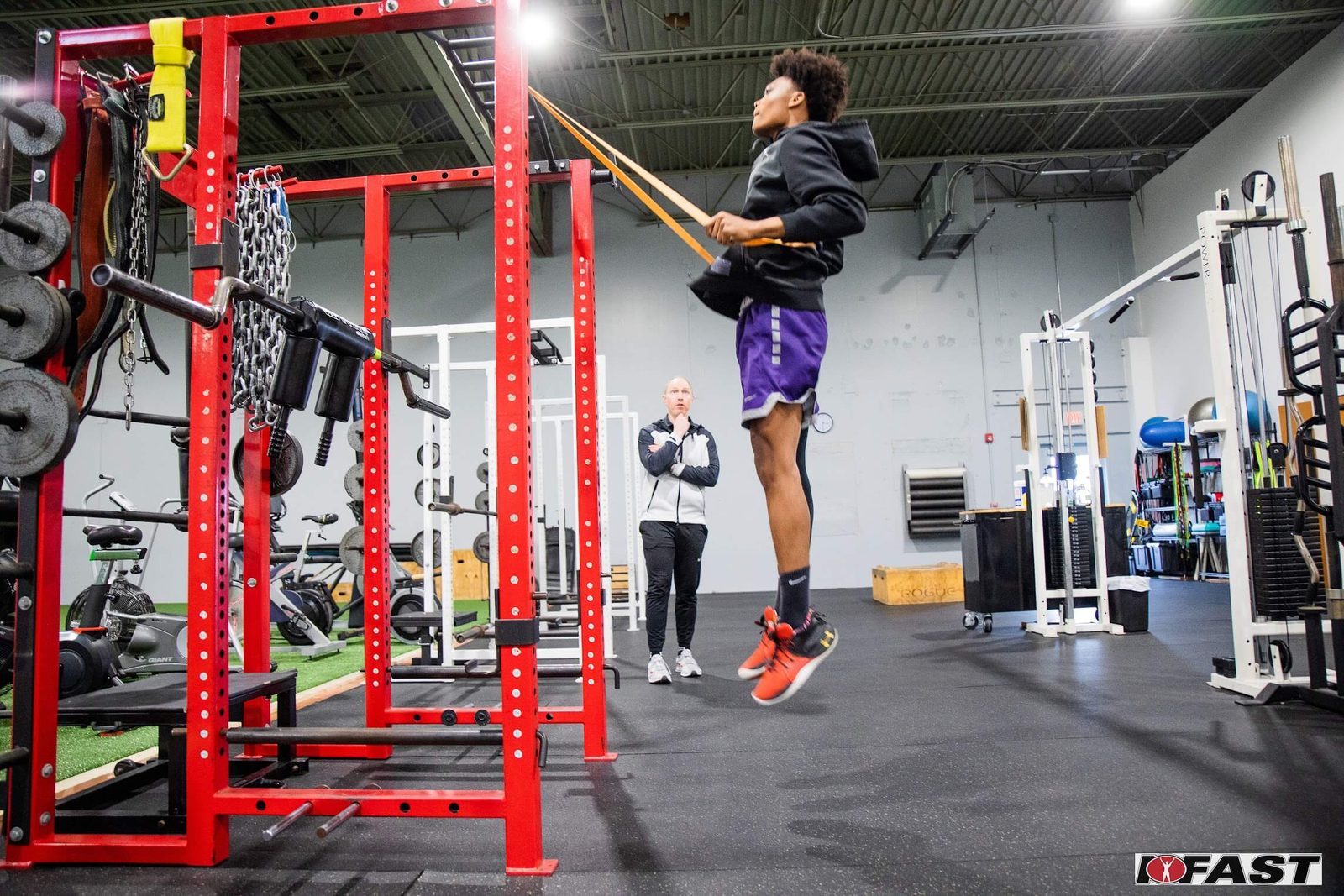
Not only is this what I do, but I’m a big believer that building a stronger, faster, more durable body can take your game to another level.
But when I think about “training” and physical development, I break it down even further:
- True Physical Development. This is your speed, strength, power, conditioning, mobility, etc. Basically, the stuff I focus on the most here at IFAST Basketball. If you haven’t read the R7 Article yet, be sure to start there, it’s the exact framework and blueprint I use to build better hoopers in the gym. And while that matters a ton, there’s also…
- Skill Development. This is your ability to pass, shoot, handle the rock, and everything that goes into being a better hooper.
So if physical development is 1A, getting your game right is 1B.
And if I’m being honest, this part is beyond my pay grade!
Sure, I can tell you if your shot looks off, but I’m not the one who’s going to help you retool your game from the ground up.
But here’s one thing I can tell you about coaching in general:
Find a skill development coach you know, like, and trust, but also one who has a real vision (and plan!) for developing your game.
This is one of those things that sounds easy on paper but is a lot harder in real life.
In my experience, the best skill development coaches are no different in their approach than a great S&C coach.
And they’re always asking the same questions:
- How do you move and play NOW? In other words, what are your strengths and weaknesses?
- How can you move and play IN THE FUTURE with the right training?
- And what’s the actual game plan or strategy to move you from A→B?
It’s not just about workouts.
It’s not about getting sweaty and tired.
It’s about deliberate, intentional work that will help YOU become a better player.
But you’ve already thought about this one, so let’s talk about the 3 areas most players don’t think about nearly enough!
Pillar 02
Nutrition and Fueling
Too often, nutrition in the US of A is dictated and driven by fat loss culture.
Scammy fad diets.
Fasting for short (or long) periods of time.
Or flat-out undereating.
I’m not going to tell you there isn’t merit to some of these things, there’s actually some interesting research on fasting, but my point is they’re probably not a great idea for you.
Here’s why…
Your goal as an athlete is to FUEL your body so you can PERFORM at your highest level.
You need to be eating a nutritious and well-rounded diet with a mix of protein, carbs, and fat.
Protein is what helps you rebuild your muscles after hard workouts in the gym or on the court.
Carbs are your body’s main fuel source, they keep your energy up during practices and games.
And fats help your body make key hormones, absorb vitamins like A, D, E, and K, and give you a steady source of energy, especially during lower-intensity work.
Another big one is hydration. If your idea of “drinking fluids” is crushing Starbucks drinks or energy drinks, we need to level up.
I challenge all my athletes to take their bodyweight in pounds, cut it in half, and then drink that much water in ounces every day.
So easy math: If you weigh 200 pounds, your target is 100 ounces of water EVERY DAY, and more on days you’re sweating through hard practices or games.
If you want to dig deeper into nutrition and fueling, sign up for my newsletter and you’ll get immediate access to my IFAST Basketball Community.
Inside, there’s an AWESOME video on performance nutrition from Christina Chu, MS, RDN, that walks you through a ton of this.
So now you’re starting to see food as fuel, something that actually helps you perform.
But what’s next?
The 4 Pillars Scorecard + 30-Day Tracker
Score yourself on all four pillars in about five minutes, find your gap, then track two or three daily habits for 30 days. Players and parents can do it together. Enter your email to download it.
Pillar 03
Recovery and Regeneration
There’s a saying in the strength and conditioning world that I wish we heard more in basketball. It goes something like this:
It’s not how hard you can train, it’s how well (and how fast) you can recover that really matters.
And in the age of social media, recovery “modalities” are all the rage.
Ice baths.
Massage guns.
You name it, and I’ve seen it.
And while I’m definitely not against recovery tools, here’s a question I’d like you to answer:
Do you really need to spend extra time in the cold tub or using the massage gun if you aren’t getting at least 8 hours of sleep every night and eating well-balanced, nutritious meals?
It’s kind of like taking a bunch of supplements to make up for the fact that you eat at McDonald’s for breakfast, lunch and dinner!
Years ago, Dr. Bill Sands ran the Recovery Center for the U.S. Olympic Committee.
After almost three years of testing every recovery tool you can imagine, he said only two things clearly worked beyond the placebo effect:
- Post-training nutrition and
- Compression (like Normatec boots)
That’s it.
Not ice baths. Not massage guns.
We’ve already talked about nutrition, and I realize not everyone has the budget for compression gear. So let’s talk about the one thing that costs you nothing and supports everything else: sleep.
Because if I could pick just one thing to improve your recovery, it’s dialing in your sleep.
When I help an athlete with their sleep, we can go in two directions:
- Sleep Quality, and/or
- Sleep Quantity
Quality is easier because it doesn’t require you to change too much about your schedule.
So one of my first goals when working with a new athlete on sleep is to improve the sleep they’re already getting so it’s deeper and more restful.
And one of the simplest wins I’ve found is creating a “Sleep Routine” or ritual.
Just like you do the same two or three steps every time you shoot a free throw, creating a sleep ritual can help make sure you’re in the right mindset to sleep and recover.
Here’s what that might look like:
- Turn your phone, TV, computer, and other screens OFF 60-90 minutes before bed.
- Take a warm shower or bath, then stretch and breathe to unwind.
- To help relax even more, try some light reading, progressive relaxation, etc.
Beyond your sleep routine, food and liquids can make a big difference with your sleep quality.
Here are a few notes that can help:
- No heavy meals within 3 hours of bed. If you crush a huge meal and then go to bed, your body is trying to process and metabolize that food, so it can’t really relax.
- No caffeine after 2 pm, or potentially earlier depending on how you respond to it.
- For my of-age athletes: no alcohol after 5 or 6 pm, if at all. It wrecks your sleep and does nothing for your performance!
Finally, your actual sleep environment has a big impact on your sleep quality.
Here are two simple tips that can help:
- Make your room as dark as possible. Turn off all the lights. Put electrical tape over all those little red and green lights. And keep it cool!
- White noise is another simple win. I like to use an app called Sleep Pillow. It helps shut out the outside world and lets your body chill out and relax.
Obviously, this topic goes way deeper than I can cover in one article, so if you want some great resources to keep learning, here are my two favorites.
Nick Littlehales is a world-renowned expert on sleep. Not only does he have a fantastic book, but I also had him on my podcast years ago to deep-dive on this topic.
Check them out below. I hope they help!
Pillar 04
Mindset and Mental Performance
After 25+ years of doing this, I truly believe that mindset is what separates the good from the great.
The ones who see consistent, sustainable success, versus those who are constantly up and down.
I’ve seen some athletes who have it all physically.
Crazy lean and ripped.
Freakishly strong.
And/or jump-out-of-the-gym athleticism.
In practice they’d look like the Alpha-Prime, literally dominating everyone who tried to match up with them.
But put them in a real game?
Or in live situations?
And the wheels fell off.
Couldn’t make a shot to save their life, or even worse, wouldn’t shoot at all.
Turning the ball over constantly.
And absolutely the worst body language and self-talk you can imagine.
That’s why this final pillar might be the most important of all: unlocking your inner game.
Because let’s be honest, you could be in great shape, game dialed in, fueling appropriately and recovering like a boss, but if your head isn’t right when you get on the court, you’re not going to perform at your best.
Period.
Again, I’m smart enough to know what I don’t know, so if you want to learn from people who are smarter than I am in this space, definitely check out these two podcast episodes below.
I think you’ll really love their insights:
Wrap-up
Putting It All Together
As a performance coach, I really wish it were as easy as just getting in the gym and getting after it every day.
Training hard (and smart) is a huge part of it, but it’s only 1 of the 4 pillars.
If that’s all you focus on, you’re leaving the other 75% on the table. Learning how to fuel your body, recover well, and build a strong mindset matters just as much.
So if you’re looking to control the controllables and do everything you can to improve your performance, pick ONE of these four pillars and start working on it today.
Do some research, come up with a game plan, and then actually stick to it for 90 days.
I guarantee if you can do this, your game is going to be a heckuva lot better as a result!
Got a question?
Ask It In The Community
The best place to ask questions about this article is the IFAST Basketball Community. It’s free to join.
Your next step
Find Your Missing Pillar
Get the 4 Pillars Scorecard + 30-Day Tracker: score yourself, find your gap, and track it for 30 days.
Not sure which program fits where you are? Take the quiz.