

The IFAST Basketball Approach to Program Design (R7)
The IFAST Approach To Program Design
R7 is how I organize every program I write. Seven blocks, in the same order, every session.
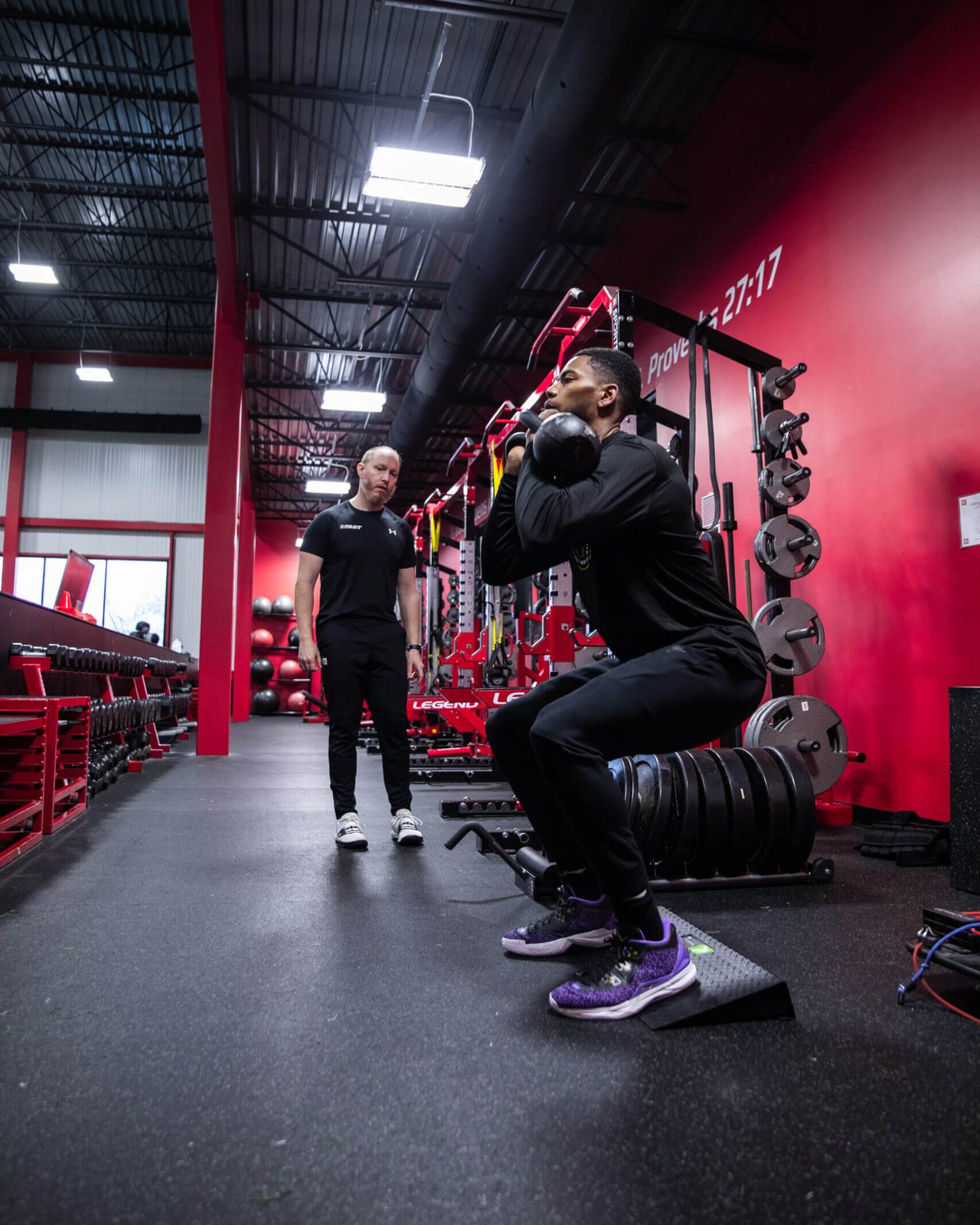
The 7 R’s at a glance
Release
Reduce excess tension and unlock mobility.
Reset
Improve posture, alignment and breathing.
Readiness
Warm up before every training session.
Reactive
Build speed, power and explosiveness.
Resistance
Get big and strong enough. No more, no less.
Resiliency
Build conditioning that lasts the whole game.
Recovery
Flip the switch to rest and digest.
Get The Template
The blank R7 sheet: daily prep plus five training days.
Program design
Why Programming Is Tough
I’ve written programs for 26 years now, and I’ve got an admission to make…
…writing high-quality training programs can be TOUGH.
And if you’re writing workouts for basketball players, that task gets even tougher!
After all, a high-level basketball player needs to be:
- Mobile,
- Strong,
- Fast,
- Quick,
- Powerful, and
- Well-conditioned
So how do you check all those boxes for your athletes?
Well it’s hard enough, but if you don’t have a system to help organize your thoughts, it’s almost impossible.
But luckily for you, I’ve created the R7 system for this very purpose, and we’re going to cover it in-depth today!
The system
An Intro to R7
The R7 approach to programming was originally crafted by myself, Bill Hartman and Eric Oetter in the early 2010’s.
Sitting in the IFAST PT room, we asked ourselves a simple question:
How do we streamline our programming across coaches, while simultaneously making it easier for our clients and athletes to understand?
Because let’s be honest: Not everyone is familiar with terminology like “soft-tissue mobilization” or “energy systems development”!
The goal was to create a programming system that would make everyone’s lives easier…
…and almost 15 years later, I’d like to think that’s the case!
R7 not only gave us coaches a shared and unified framework to build from, but it gave our athletes language that was simple and easy to understand.
For reference, here are the 7 R’s:
- R1: Release
- R2: Reset
- R3: Readiness
- R4: Reactive
- R5: Resistance
- R6: Resiliency
- R7: Recovery
Now without any context whatsoever, I’d imagine just those words alone will give you some clues as to what physical qualities we’re trying to develop.
But just in case, let’s dive into all 7 R’s, and I’ll explain exactly what I’m trying to accomplish at every stop in a workout.
R1
Release
As every hooper gets bigger, faster, stronger and older, a few things tend to happen:
- Certain muscles (like quads and calves) can get short, and
- Connective tissues (like the fascia that connects the entire body) get stiff.
Now up to a certain point, this can be helpful, or even performance enhancing.
But when it becomes excessive, or you can’t access certain postures and positions, it can lead to pain, discomfort, or even a decrease in performance.
So before I get an athlete moving, I’ll have them use a foam roller, lacrosse ball, or stick to help reduce excess tension and unlock mobility.
Typically a few minutes, spent working on the right areas, can give us a huge return on our investment.
R2
Reset
The term “reset” can mean a lot of things to different people.
For some, it’s static breathing exercises.
For others, it may be lower-level activities like gentle rolling, targeted joint mobilizations, etc.
But for me, a reset is any activity that can help improve posture, alignment, or recapture the ability to BREATHE in a more dynamic fashion.
Now a small caveat here: There is no such thing as “perfect” posture, or any one way that’s “ideal” to breathe.
Instead, resets should give our body more freedom of movement so we can move well, and feel great, on the court.
Much like our release work, I find that as hoopers age, mature, and develop, resets become infinitely more important.
Not only does this total body unlock decrease wear and tear, but often leads to big improvements in performance as well.
R3
Readiness
Okay I’m going to state the obvious here…
…yes, you do in fact have to warm-up before EVERY training session!
Look, you might be able to get away with jumping right into a lift, individual workout or run when you’re a teenager, but the older (or higher level) you get, the more important a solid warm-up is.
If nothing else, just remember that warmer tissues = higher performing tissues.
After all, you’re not seeing world-class sprinters hit PR’s on cold tracks in the snow!
Now the next question becomes, what should you be doing in your warm-up?
Personally, I like to do a blend of dynamic stretches/mobility drills, paired with more dynamic/rhythmic activities to prep my athletes for their training sessions.
And while I’ve tried different iterations over the years, as a standard “get people moving” circuit, the following exercises work really well.
This warm-up will help cement the postures/positions necessary to move well, and will smooth that transition from rolling and resets to lifting and on-court activities.
Get The R7 Training Template
The blank version of the system in this article. One page of daily prep, then a page for each training day. Type into it on screen or print it. Enter your email to download it.
R4
Reactive
Question and answer time…have you ever heard a hooper say any of the following:
- My bounce is too elite,
- My first step is too fast, or
- I’m just too quick coming in and out of cuts
I don’t know about you, but I definitely have not!
But for some reason, too many strength coaches out there spend ALL their time and energy just chasing strength.
Now look, I love strength.
I was a powerlifter off-and-on for 11 years because I love the weight room and getting stronger.
But I also realize that strength is just ONE PIECE of the puzzle.
Instead, if we want to make truly elite hoopers, we must spend time building their speed, power and explosiveness!
Talk to any athlete that has played at the highest levels, and they’ll tell you that the SPEED of the game gets infinitely faster.
I generally think about 4 main ways hoopers move on the court:
- Linear: 1st step quickness and sprinting down court (Note: backpedaling can fit in here as well)
- Lateral: Shuffling, lateral running, crossovers, etc.
- Curvilinear: Which is a blend between linear/lateral work and
- Vertical: The ability to get up off 1- or 2-legs
From there, I’ll break those categories down into two different themes:
- Braking: The ability to slow down/stop and
- Propulsion: The ability to project forward, laterally, or vertically
So put it all together, my goal is to train all of these qualities:
- Linear Braking and Propulsion
- Lateral Braking and Propulsion
- Curvilinear Braking and Propulsion and
- Vertical Braking and Propulsion
Now I don’t want to nerd out on this too hard, but I do want to reiterate this point:
My goal as a coach is to make athletes fast, powerful and explosive across numerous postures, positions and movement patterns.
The weight room is absolutely important, but never forget about (or neglect) speed and power development!
R5
Resistance
Now it’s time for the good stuff: let’s get JACKED!
In all seriousness, the best thing about the weight room is it allows our athletes to get bigger and stronger.
And up to a point, general strength and the physical maturation process can make a huge impact on how our athletes perform on the court.
Whether it’s a quicker first step, bigger vertical jump, or just their ability to hold their ground and not get pushed off their line, the weight room can definitely help build a better all round hooper.
But notice I said “up to a point.”
What often happens is a young coach sees that immediate improvement in sports performance, and immediately assumes that if some strength is good, even more is better.
And it can definitely get you in trouble, because I was that coach back in the day myself!
What ends up happening is if you push strength too hard, or for too long, what was helpful before now holds the athlete back!
They actually start to lose that 1st step quickness.
Their mobility decreases and they look stiff.
And often, their body hurts when they walk out of the weight room, which is obviously the last thing we need!
My goal when I train a hooper is to make them big and strong ENOUGH, no more, and no less.
But I also think there are two lesser known (or talked about) reasons you should be in the weight room:
- To improve overall movement, and
- To strengthen that muscle-tendon junction.
The first one should be straightforward.
A good coach realizes that the weight room is an awesome place to teach athletes how to move their own bodyweight more effectively.
It could be squatting, lunging, doing push-ups and pull-ups, etc.
But I’m a big believer that just teaching athletes how to move more effectively is a huge benefit of strength training.
Second, with young players getting on the court more than ever before, I really think we need the weight room to strengthen the tendons.
Plyometrics and jumping will help to a degree, but the research shows time and again that heavy, slow resistance training can do wonders for cranky tendons.
To wrap this up, the take-home message here is simple: Strength training is a huge part of the puzzle, we just need to utilize it effectively.
R6
Resiliency
I hate to be the bad guy here, but making someone tired and sore IS NOT difficult.
Case in point: In the early 2000’s I was helping rehab a young softball player who was dealing with lower back pain.
She was doing great and ready to get back on the field, until one day she could hardly walk coming into the gym.
I asked her what had happened, and she said her coach had made her do walking lunges all the way around the track.
FOR TWO LAPS.
Was she tired? Yep.
Was she sore? Absolutely.
But was she any better conditioned? Absolutely not.
Look, improving conditioning isn’t just about working hard or killing yourself, despite what the Instagram and TikTok coaches are telling you.
And actually, a lot of the super-high intensity work you see glorified nowadays makes conditioning WORSE.
Instead, the goal is to put together a well-rounded program that gives a basketball player the ability to be fast and explosive for 32, 40 or even 48+ minutes.
Now I promise I’ll do more articles on this topic in the future, but for now, just recognize there are two “buckets” I think of for conditioning:
- General: This is just the standard stuff that gives an athlete the ABILITY to play longer. Often times it’s not sexy or exciting, but you have to build that foundation first.
- Specific: This is where you take that general base and make it sport-specific (think planting, running, cutting and changing directions on the court).
Again, this topic could be an entire course or webinar in-and-of itself, but just respect the fact that killing yourself in the name of “hard work” isn’t always the answer.
R7
Recovery
The final step to wrapping up an awesome training session is to kick-start the recovery process.
Now here’s a 1-minute physiology primer for you:
Within your body, you have an autonomic nervous system (ANS).
I like to think automatic because it works without you having to think about it.
And furthermore, within that ANS you have two branches:
- Sympathetic: Think fight-or-flight, and
- Parasympathetic: Think rest and digest.
When you’ve been training hard, your body taps into the sympathetic nervous system to help you run fast, jump high, and perform at your very best.
But when you’re done?
You need to flip that switch: it’s time to rest and digest!
Now don’t overthink this part: It can be as simple as lying with your legs and feet elevated up against a wall and just breathing deeply for 3-5 minutes.
Whatever you do, we’re just trying to get that parasympathetic branch firing so you can rest, recover, and be ready to train hard in your next workout!
Wrap-up
Summary
Okay my friends, there you have it: 26 years of program design knowledge wrapped into less than 2,000 words!
But in all seriousness, I hope this article has given you some insights into how I write programs, and how to maximize the training programs of all the athletes you work with.
Thanks so much for reading and have a great day!
MR
BTW: A few quick notes…
- Want to download my latest R7 Template? Check that out HERE.
- Got questions about the article? Join the IFAST Basketball Community, it’s FREE.
- And if you need a program to follow, here’s my Off-Season Workout Program, or how we can work together to help you achieve your goals!
Got a question?
Ask It In The Community
The best place to ask questions about this article is the IFAST Basketball Community. It’s free to join.
Your next step
Put R7 To Work
Get the R7 Training Template: daily prep plus five training days, fillable on screen or printed.
Not sure which program fits where you are? Take the quiz.